

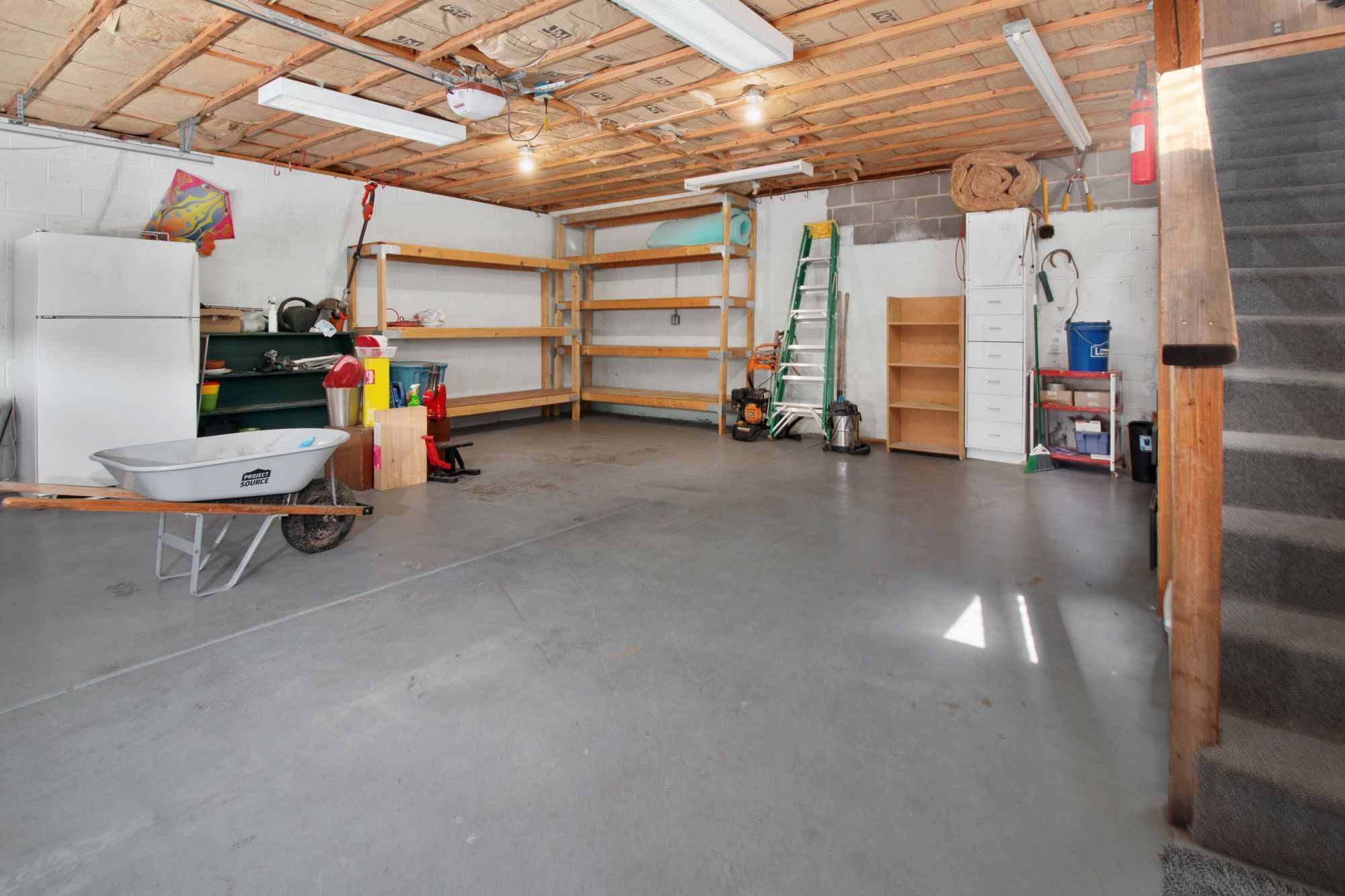
For full width, depth, and ceiling numbers, see our golf simulator room dimensions guide. This page covers what's different about garages.
Start with the garage door
The garage door is the first thing to check. The Net Return points out that garage door rails sit low in some spots. Carl's Place says you don't want to keep worrying about hitting an overhead door when you tee off.
Here's how to check:
- Stand where you'd hit. Swing a driver slowly, or raise one straight overhead.
- Look at the door when it's closed, and again when it's open. An open door sits flat along the ceiling tracks and can be lower than you expect.
- Check the opener rail and motor. They usually hang in the middle of the ceiling, often right above the hitting area.
The Net Return also suggests hitting driver with the door open, when the panels move out of the way and leave more room overhead.
If a ceiling opener is in the way, there's another option. Chamberlain sells a wall-mounted opener. Chamberlain says it "frees up ceiling space" and installs "on either side of the garage door." Have a garage door pro check whether it works with your door before you plan around it.
Depth: radar units need room behind the ball
Garages are often long enough. Still, check the depth your launch monitor needs, because radar units sit behind the ball, not beside it.
- Garmin Approach R10: Garmin's manual says to place it 6 to 8 feet behind the tee. It also says the tee must be at least 8 feet from the net indoors.
- FlightScope Mevo+: FlightScope says Mevo+ sits 8 feet behind the tee location, indoors or outdoors. Its FAQ says aluminum stickers (or Titleist RCT balls) are needed for accurate spin readings in limited flight.
- Rapsodo MLM2PRO: Rapsodo says you need 8 feet from ball to net, plus another 6.5 to 8.5 feet behind the ball. That's a little more than 14 feet in total.
For general room size, Carl's Place calls 14 feet wide by 18 feet deep by 10 feet high ideal for a garage simulator. Shop Indoor Golf says most garages should be at least 10 by 10 feet with a 9-foot ceiling for a small mat-and-net setup. Our room dimensions guide has more detail.
Temperature: check the manuals
Garages get cold in winter and hot in summer. The Net Return lists "temperature swings" as a key garage issue. Foresight Sports' care guide says to avoid storing its devices in hot cars, garages, or damp basements.
Here's what the manuals say:
| Device | Spec from the manufacturer | Source |
|---|---|---|
| Garmin Approach R10 | Operating: 14°F to 131°F (-10°C to 55°C). Charging: 32°F to 113°F (0°C to 45°C) | Garmin owner's manual |
| BenQ AH500ST and AH700ST projectors | Operating: 32°F to 104°F (0°C to 40°C) | BenQ spec pages |
| Optoma ZK431ST-B projector | Operating: 32°F to 104°F (0°C to 40°C); humidity up to 80% RH, non-condensing | Optoma datasheet |
| Uneekor EYE MINI | Storage: no colder than 20°F and no warmer than 110°F | Uneekor manual |
| FlightScope Mevo+ | Storage: ideally 60°F to 70°F | FlightScope FAQ |
What this means for planning:
- A garage can fall below a projector's 32°F floor in winter. If you live somewhere cold, plan on some heat.
- Uneekor says not to use the EYE MINI where there's high humidity, smoke, or dust. Foresight says to keep the area around a mounted device dust-free so the lens stays clear.
- If you can, bring portable launch monitors inside between sessions.
Sharing the garage with a car
Lots of people still park in the garage. Carl's Place says many of its customers plan to keep using the garage for vehicles or storage. It suggests net extensions to protect a parked car.
Here are the main ways to share the space:
- Two-car garage, one side for golf. The Net Return says you can keep one side set up and hit any time, without moving the car on the other side.
- Single-car garage, daily setup. The Net Return describes backing the car onto the driveway and pulling the net into place.
- Retractable screen. Rain or Shine Golf makes the G-Trak, a screen it says is built for garage installations. It retracts by hand along a ceiling track that mounts to the ceiling joists, with "no tools, no disassembly." Rain or Shine lists sizes for 8-foot to 16-foot garage doors.
- Take-down enclosure. Carl's Place suggests its DIY enclosures for smaller spaces because they're easier to take down and put back up.
Plan the setup and teardown routine before you buy. A setup that's annoying to put out tends to stay packed away.
Flooring on concrete
Most garages have concrete floors. Carl's Place says a golf mat is a must in a garage simulator. The Net Return says bare concrete plus a mat "can be noisy and hard on joints." It suggests thin foam tiles under the turf and rubber pads under the net's feet. Our hitting mat guide covers what to look for in the mat itself.
Light, power, and security
- Windows and light. Carl's Place says that if your garage has windows or a lot of ambient light, you'll want a projector with higher lumen output. Shop Indoor Golf recommends even, indirect light and lights that don't flicker, since flicker can interfere with simulator cameras.
- Power. Uneekor says to plug the EYE MINI into a 100-240V AC outlet using only the supplied adapter. Count what you'll plug in (projector, PC, launch monitor) and check where your outlets are before you pick a layout.
- Security. Garages get opened all day. Plan where expensive gear will live when you aren't playing, and think about locking up or taking inside anything portable.
Garage golf simulator planning checklist
- Measure width, depth, and ceiling height. Then compare them with our room dimensions guide.
- Swing-test under the door tracks and opener, with the door both open and closed.
- Decide whether the opener needs to move, and talk to a garage door pro if it does.
- Confirm your launch monitor's distance behind the ball and to the net from its manual.
- Look up the operating temperature for your launch monitor and projector.
- Plan heat, insulation, or both if winter temps fall below those ranges.
- Choose how you'll share space with a car: split bays, daily setup, retractable screen, or take-down enclosure.
- Plan protection for anything parked or stored near the hitting area.
- Pick a mat, plus foam or rubber underlay for the concrete.
- Check your window light and choose projector brightness to match.
- Map your outlets and cable runs.
- Decide where gear lives between sessions.
Want this matched to your exact garage? Enter your measurements in our free room-fit builder.
FAQ
Can you put a golf simulator in a garage with a car? Yes, many people do. Common approaches are using one bay of a two-car garage, setting up each session, or using a retractable screen that stores along the ceiling.
How big does a garage need to be for a golf simulator? Shop Indoor Golf says at least 10 by 10 feet with a 9-foot ceiling for a small mat-and-net setup. Carl's Place calls 14 by 18 feet with a 10-foot ceiling ideal. Radar units also need room behind the ball. See our room dimensions guide.
Is a 2 car garage big enough for a golf simulator? Often, yes. Measure first, especially ceiling height under the door tracks and the opener.
Will cold weather affect a garage golf simulator? It can. The BenQ and Optoma projectors listed above are rated to operate from 32°F. Garmin rates the R10 down to 14°F. Check your own manuals.
Do I need to move my garage door opener? Only if it's in your swing path. Swing-test first. A wall-mounted opener is one way to free up ceiling space.
Sources
- Garmin Approach R10 Owner's Manual, Specifications
- Garmin Approach R10 Owner's Manual, Preparing for a Shot
- FlightScope, Setting up your Mevo+
- FlightScope Mevo and Mevo+ FAQ
- Rapsodo Golf FAQ
- BenQ AH500ST Specifications
- BenQ AH700ST Specifications
- Optoma ZK431ST-B datasheet
- Uneekor EYE MINI Manual
- Foresight Sports, How to Care For and Maintain Your Device
- Rain or Shine Golf, G-Trak Retractable Screen
- Carl's Place, Garage Golf Simulator: An Easy DIY Setup
- The Net Return, How To Build a Garage or Basement Golf Setup
- Shop Indoor Golf, Garage Golf Simulators: Guide & Tips
- Chamberlain RJO101 Wall Mount Garage Door Opener