

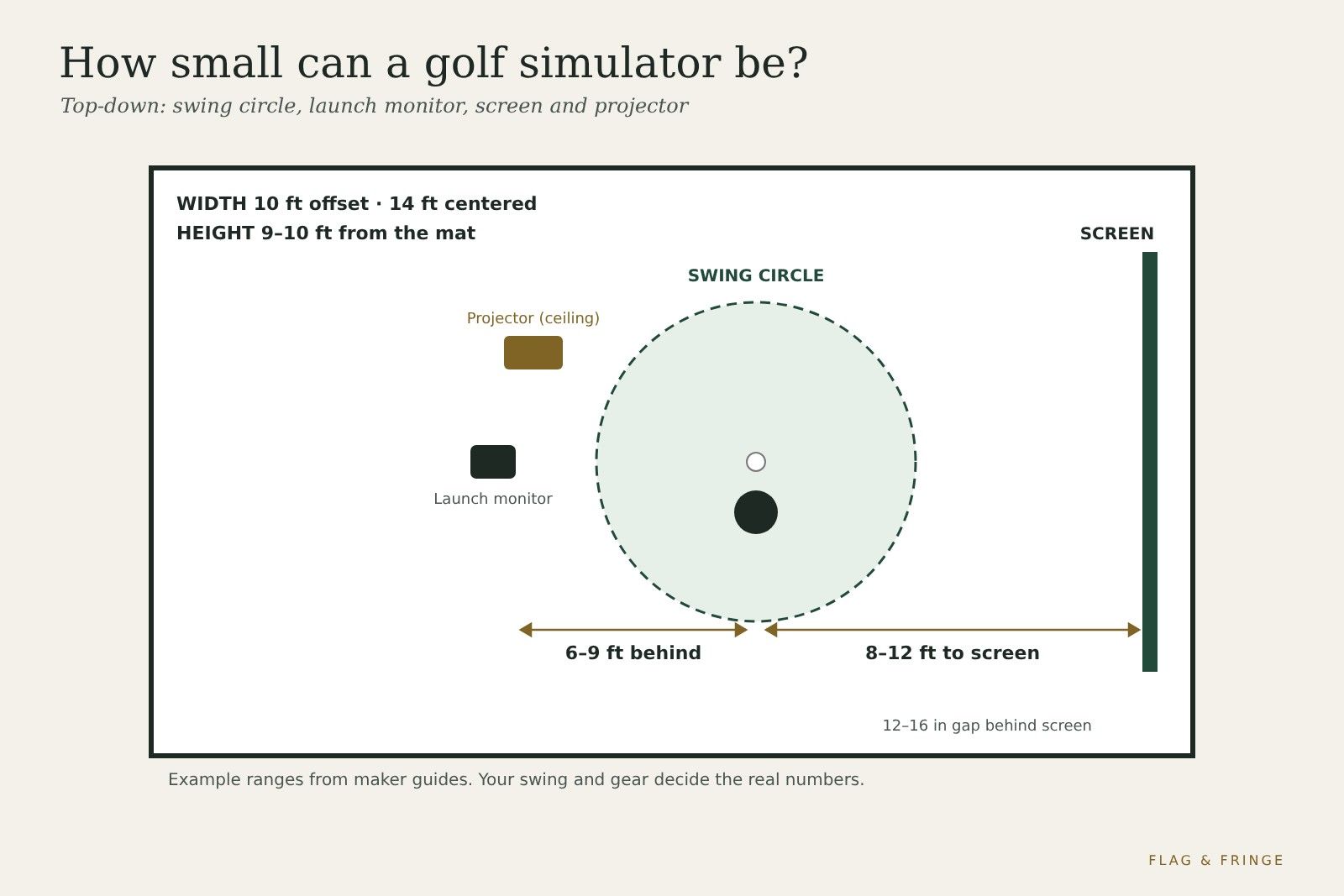
There's no single minimum size for a golf simulator. The smallest room that works is set by four things: your swing, where your launch monitor sits, how far the ball flies before the screen, and where the projector goes. Here's how to size each one, with the numbers the makers publish.
The short answer
- Smallest published product minimum we found: Garmin lists 15 ft long × 8 ft wide × 8 ft high for the Approach R10 indoors.
- A workable tight room: about 10 ft wide (hitting spot offset), 15–17 ft deep and 9 ft high, if your swing fits.
- A comfortable room: 14 ft wide (hitting spot centered, so lefties and righties can share), 17–20 ft deep and 10 ft high.
For the full maker-by-maker table, see our golf simulator room dimensions guide. This article explains where each number comes from, so you can size your own room.
Start with your swing radius
Everything else fits around the golfer, so start there. Your swing sweeps a circle around you: your arms plus the club. The driver is the longest club you'll swing indoors. The Rules of Golf cap club length at 48 inches (putters excepted), and many drivers are shorter than that.
Carl's Place plans a swing area of about 7 ft around the golfer in every direction for most launch monitors. That's a planning number, not a measurement of you. Your arms, club and swing decide the real circle.
Test it before you buy. Trackman's advice is to take your longest club and make full swings in the room before committing to equipment. Carl's Place puts it simply: if you can swing easily without changing how you swing, the space should work. Rapsodo suggests the ceiling be 6–9 inches higher than the top of your swing.
Don't forget practice swings
A practice swing is a full swing too, and it often happens a step to the side of the ball, where the room is tighter. Our planning advice:
- Take practice swings on the hitting spot, not beside it. That's the spot you measured.
- Mark the swing circle on the floor with tape. It shows guests where not to stand.
- One swinging golfer at a time. The next player waits outside the circle. SimSpace's safety guide says everyone should keep a safe distance from the swing area during use.
If you share the room with a left-handed golfer, mark both stances. A spot that's clear for a righty can put a lefty's swing into a wall. For the house rules that keep a crowded sim night safe, see our golf simulator safety guide.
Width: offset or centered
Width depends on where you put the hitting spot.
| Layout | Width makers suggest | Why |
|---|---|---|
| Offset hitting spot (one handedness) | About 10 ft (Carl's Place, SkyTrak); 9–10 ft minimum (Shop Indoor Golf) | The golfer stands off center, so the swing has room on one side |
| Centered hitting spot | At least 14 ft (SkyTrak, Shop Indoor Golf) | Room for left- and right-handed golfers on the same spot |
| Both handedness, roomy | About 15 ft (Trackman) | Trackman's benchmark for a bay that suits both |
Offsetting the tee saves width but can change how the ball lines up with the screen and launch monitor. Check your monitor's alignment instructions before you commit.
Depth by configuration
Depth is where launch monitors differ most. Radar units sit behind the ball; camera units sit beside it. Add the screen gap on top.
| Setup | Monitor position | Ball to screen or net | Monitor-to-screen span |
|---|---|---|---|
| Garmin Approach R10 | 6–8 ft behind the tee | At least 8 ft | 14–16 ft (Garmin's room minimum: 15 ft long) |
| Rapsodo MLM2PRO | 6.5–8.5 ft behind the ball | 8 ft | 14.5–16.5 ft |
| Rapsodo MLM2XPRO | 7.5 ft behind the ball | At least 8 ft | About 15.5 ft |
| FlightScope Mevo+ (recommended full swing) | 7–9 ft behind the tee | 13 ft | 20–22 ft |
| Foresight GC3S (camera, beside the ball) | 16–24 in beside the hitting zone | Set by your screen; Carl's Place and SkyTrak suggest 10–12 ft | Depth is mostly swing room plus screen distance |
The gap behind the screen. An impact screen needs room to give. Carl's Place says keep the screen 12–16 inches off the wall; SkyTrak says ideally about 2 ft. Count that in your depth.
Room behind the golfer. With a camera unit beside the ball, you still need your backswing behind you. Shop Indoor Golf suggests at least 7 ft behind the tee.
Projector distance by configuration
The projector needs its own distance from the screen, and it has to stay out of your swing and out of the ball's path.
- Ceiling-mounted behind the golfer (most common). BenQ says a short-throw projector can be mounted above and behind the hitting area without the golfer casting a shadow, no more than about 3–4 ft behind the player. Carl's Place says it should be high enough that the backswing and follow-through never come close.
- Floor or cart behind the golfer. Carl's Place says this almost always causes shadows, and BenQ rates a cart mount as the highest shadow risk.
- On the floor in front (ultra-short-throw). It sits near the ball's path. Carl's Place calls a protective enclosure basically a must for floor-mounted projectors. See our ultra-short-throw notes in the throw ratio guide.
How far back the lens goes depends on throw ratio and image size. Example from our throw ratio guide: a 4:3 image 7.5 ft tall from a 16:9 projector needs the lens about 6.7 ft from the screen at a 0.499 ratio, about 9.2 ft at 0.69 and about 11.9 ft at 0.89. BenQ also suggests keeping the projector about 7–8 ft from the screen to stay clear of ball strikes.
Height
Rapsodo says most simulators need at least 9 ft, and golfers over about 5'8" may need 10 or 11 ft. SkyTrak sells a Studio for rooms with 8 ft ceilings. Measure from the top of the hitting mat, not the floor: a 2.5 in mat takes 2.5 in off your swing room. Our ceiling height guide covers overhead launch monitors and low-room fixes.
Putting it together: tight vs comfortable
| Item | Tight room | Comfortable room |
|---|---|---|
| Width | About 10 ft, hitting spot offset | 14 ft, hitting spot centered |
| Depth | 15–17 ft (radar unit behind the ball) | 17–20 ft |
| Height | 9 ft from the mat (shorter golfers) | 10 ft |
| Projector | Short throw, ceiling mount behind the golfer | Same, with more image size |
| Who it suits | One golfer, one handedness, tested swing | Lefties and righties, guests, full driver swings |
Minimum size checklist
- Swing your driver slowly on the exact hitting spot, on the mat you'll use.
- Mark the swing circle with tape and keep it clear.
- Decide offset or centered, and check both stances if lefties will play.
- Add your launch monitor's distance behind or beside the ball.
- Add the maker's ball-to-screen distance and 12–24 in behind the screen.
- Work out the projector's lens distance from its throw ratio, and keep it above and behind you.
- Measure the ceiling from the mat, along the whole swing path.
Then run your numbers through the Flag & Fringe builder. It checks your room against the gear you're considering.
Garmin Approach R10
The smallest published indoor room minimum we found: 15 ft long, 8 ft wide and 8 ft high, with the R10 6–8 ft behind the tee.
- Best for
- Tight rooms with a full-length layout
- Watch out for
- Still test your swing; the room minimum doesn't check your clearance.
Flag & Fringe may earn a commission if you buy through these links, at no additional cost to you. As an Amazon Associate I earn from qualifying purchases.
Rapsodo MLM2XPRO
Sits 7.5 ft behind the ball with at least 8 ft to the net, so plan about 15.5 ft from device to screen.
- Best for
- Rooms around 16–17 ft deep
Flag & Fringe may earn a commission if you buy through these links, at no additional cost to you. As an Amazon Associate I earn from qualifying purchases.
SIGPRO Softy LITE 4' x 5' golf mat
At 1 1/4 in thick (Shop Indoor Golf's listing), it raises you less than thicker mats, which helps in a low room.
- Best for
- Low ceilings
Flag & Fringe may earn a commission if you buy through these links, at no additional cost to you. As an Amazon Associate I earn from qualifying purchases.
FAQ
What is the minimum room size for a golf simulator?
There's no universal minimum. The smallest maker minimum we found is Garmin's 15 × 8 × 8 ft for the R10. Most makers suggest more: about 10–14 ft wide, 17–20 ft deep and 9–10 ft high.
How much width do I need to swing a driver?
Carl's Place plans about 7 ft around the golfer. Makers suggest about 10 ft wide with an offset hitting spot, or 14 ft to center it. Test your own swing.
How far should I stand from the screen?
Carl's Place and SkyTrak suggest the tee be 10–12 ft from the screen. Some launch monitors list a minimum of 8 ft from ball to net.
How far should the projector be from the screen?
It depends on the throw ratio and image size. For a typical 4:3 image 7.5 ft tall, short-throw projectors land roughly 6.7–12 ft from the screen.
Is a 10 × 12 room big enough?
Usually not for a radar launch monitor behind the ball, which needs about 14–16 ft from device to screen. It may work for some setups with a camera unit beside the ball and shorter clubs. Test your swing first.
I may earn a commission if you buy through these links. As an Amazon Associate I earn from qualifying purchases.